Here are the best 40 AI tools to spark your productivity in 2025 and keep you ahead of your competition
The best AI tools by category
- AI assistants: ChatGPT, Grok, Claude, Gemini
- Video generation: Synthesia, Google Veo, OpusClip
- Image generation: GPT-4o, Midjourney
- Meeting assistants: Fathom, Nyota
- Automation: n8n, Manus
- Research: Deep Research, NotebookLM
- Writing: Rytr, Sudowrite
- Search engines: Google AI Mode, Perplexity, ChatGPT search
- Graphic design: Canva Magic Studio, Looka
- App builders & coding tools: Lovable, Cursor
- Knowledge management: Notion Q&A, Guru
- Email: Hubspot Email Writer, Fyxer, Shortwave
- Scheduling: Reclaim, Clockwise
- Presentations: Gamma, Copilot for PowerPoint
- Resume builders: Teal, Kickresume
- Voice generation: ElevenLabs, Murf
- Music generation: Suno, Udio
- Marketing: AdCreative, AirOps
How the AI Software in This List Was Selected
This article lists 45 AI tools across 20 different categories. After exploring the available options in each category, the best tools have been selected based on practical use. This ensures that the recommendations are grounded in what works effectively.
For each tool, the focus is on its best use cases, explaining when and how it can be most useful. The content also covers the strengths of each tool, as well as any potential downsides. Additionally, information is provided on the free version and premium pricing plans for each tool.
Free AI tools
For those looking for free AI tools, every tool listed in this article offers either a free plan or a free trial with no credit card required. This allows users to explore their features and functionality without any commitment.
The best AI assistants
ChatGPT
ChatGPT is a well-known name, used daily for a wide range of personal and professional tasks.
It remains a popular AI assistant, even as alternatives have become much stronger contenders since its initial launch.
One of its key features is the ability to upload and analyze files. Users can drop in PDFs, spreadsheets, screenshots, and more, then ask ChatGPT to summarize, analyze, or extract data. For example, uploading a screenshot of a funnel analysis from Google Analytics can yield useful insights into user drop-off points.
It can also be used to analyze spreadsheets. By uploading raw survey data, it can provide clear trends, key insights, and even recommendations for the best chart types for visualization, saving hours of manual work.
ChatGPT is free to use, but the free tier comes with limited access to the latest models. The Plus plan, currently $20/month, unlocks full access to advanced features and faster performance.
Grok

While Grok can be used as a standalone AI assistant, it is most likely to be seen in action on X (formerly known as Twitter).
It is debatable whether the Grok integration improves the platform, as many comments now involve users tagging Grok to fact-check the original poster. This may hold people more accountable to the truth, but it has also disrupted the natural flow of conversation.
Grok is a very smart model, and a notable aspect is its lack of censorship. It comes with several reasoning modes, like 'Think', which gives the model more time to process and refine its response, and 'Deep Search', which searches the internet in a RAG-style manner.
The lack of censorship also extends to its impressive image generation capabilities, which makes it a suitable choice for generating pictures of celebrities, brands, or memes.
You can try Grok for free with limited access, but to unlock higher usage limits and the latest models, you'll need one of X’s paid tiers: Basic, Premium, or Premium+.
Claude
Claude has been a go-to AI assistant for coding for some time. While other tools are catching up, it is widely considered that most developers favor Claude. It is a frequent choice for various coding tasks.
It’s especially good at writing clean, well-documented code, and even better at explaining what that code does in plain English. Claude's code is often noted for its reliability, with fewer issues related to hallucinated variables or broken logic compared to some alternatives.
Claude's communication style is often described as collaborative, feeling as though it’s solving the problem with the user, not just providing answers to be managed.
Claude is free to use, with a Pro plan at $20/month for more features and usage, and a Max plan starting at $100/month for higher limits and early access.
Gemini
Gemini is Google’s AI assistant, and at the time of writing, it sits at the top of the LLM Arena leaderboard—a ranking based on millions of blind tests where users choose their favorite AI responses.
One of the main reasons for using Gemini is its large context window. This refers to the amount of text an AI can remember and work with during a conversation. The latest Gemini models support over 1 million tokens of context, allowing users to input lengthy documents and ask follow-up questions without losing context.
Another notable feature is Gemini’s audio overview. With it, a user can upload a document and get a podcast-style, five-minute audio summary hosted by AI voices, which is perfect for digesting long documents on the go.
Gemini offers a free plan with basic AI tools, while paid Pro and Ultra plans unlock more advanced models, creative features, and increased storage. Pricing starts at $19.99/month for Pro and $124.99/month for Ultra.
The best AI video generators
Synthesia
Synthesia is a leading AI video generator that allows users to generate realistic AI human avatar videos. It is often used for creating training modules and presentations, making it a favorite for learning and development teams. By turning text into video, Synthesia simplifies the production of high-quality content without the need for cameras, microphones, or studios.
Its most popular use case is training videos, but Synthesia is versatile enough to handle a wide range of needs. Businesses use it for internal communications, onboarding new employees, and creating customer support or knowledge base videos. On the marketing side, it excels in producing personalized sales outreach videos, B2B marketing content, explainer videos, and even product demos.
It is also handy for website videos that need a polished, professional touch with minimal effort. The platform is easy to use; users just type in a script and then generate the video.
Two notable features of Synthesia are the ability to customize avatars and the wide variety of templates offered. For users needing to create tailored training videos for different departments, Synthesia makes it easy to switch the avatar language, tone, or background to suit the audience. The library of over 230 digital avatars and support for 140+ languages means users can create globally consistent content effortlessly.
While Synthesia shines for AI talking head video generation, it’s not designed for storytelling or cinematic visuals. It’s best for teams and businesses that prioritize speed, professionalism, and brand consistency in their video production workflows.
Synthesia offers a free plan that allows users to generate up to 36 minutes of video per year, with no credit card required. For more extensive features, paid plans start at $29 per month.
Google Veo
Google's Veo is an impressive tool for generating creative AI videos, capable of producing visuals for almost anything—though its content moderation is fairly strict.
Veo is often used to create b-roll for social media marketing videos. Veo 2 is quite affordable, and while it occasionally produces odd results with action scenes, the physics are among the most realistic seen in AI-generated video.
Veo 3 is more expensive but adds the ability to generate audio as well, which makes it significantly more useful.
You can try Veo 2 for free in Google AI Studio, where a limited number of free credits are available for testing.
To access Veo 3, you’ll need either the $19.99/month Google AI Pro plan or the $249.99/month Ultra plan.
OpusClip
OpusClip is a great tool for breaking down longer videos into short, shareable clips for social media. It’s straightforward to use and does a lot of the heavy lifting.
The AI feature is surprisingly effective at finding the best parts of a video, which saves users from spending ages scrubbing through footage. It also resizes clips automatically to fit platforms like TikTok and Instagram.
Adding captions is quick and simple, and the option to add emojis makes the clips feel more dynamic—especially useful for grabbing attention in silent scrolling. Another useful feature is the “hook” tool that picks out key moments to start the clip off strong.
Opus Clip makes it easy to create eye-catching content from existing videos. It’s practical, efficient, and takes some of the hassle out of social media editing.
The best AI image generators
GPT-4o
The trend of generating Studio Ghibli–style AI images was powered by the built-in image generation in ChatGPT-4o.
It supports both text-to-image and image-to-image transformations across a wide range of art styles, making it useful for all kinds of tasks. It can be used to create royalty-free images for blog posts and social media posts. Now that it can reliably generate text within images (something earlier tools struggled with), it's even more valuable.
The feature is available on the free tier of ChatGPT, though there are daily usage limits. Those can be lifted by upgrading to a Plus or Pro plan.
Midjourney

Midjourney can be considered the original AI image generation tool. It’s been around since early 2022 and is still often favored for its painterly aesthetic and for creating source images for image-to-video generation.
While built-in image tools in AI assistants are common, Midjourney is often chosen when the goal is to generate something genuinely beautiful.
One downside is that Midjourney no longer offers a free plan; a subscription to a paid tier is required to generate any images. There are four plans available, starting at $10/month, with higher tiers offering more generation time and advanced features like video support and stealth mode.
The best AI meeting assistants
Fathom

Fathom is a widely used and practical AI tool. It’s an AI notetaker that joins Zoom or Microsoft Teams meetings, records the entire conversation, and tracks who said what. It is useful for users who need to recall action items, revisit explanations, or double-check what someone said.
Alongside a full transcript, Fathom generates a clear, structured summary. The notes are generally found to be accurate and well-organized.
The app is free to use with a few limits. Premium plans start at $19/month and unlock unlimited AI features and deeper integrations. For what it offers—especially how well it captures questions and action items—it’s a competitive tool.
Nyota

While Fathom is a solid free option, Nyota can be considered a more premium, polished version with some impressive extra features. Like Fathom, it records meetings and generates AI-powered transcripts and summaries. But Nyota goes further by automating the follow-up tasks that usually consume time after a call, such as data entry and updating a CRM based on what was discussed.
This allows users to have a call with a prospect and, without lifting a finger afterward, get a full summary and see their CRM updated with key points from the conversation. This level of automation is a significant benefit.
Of course, those extras come at a cost. Nyota is a paid tool, though it does offer a 7-day free trial. Pricing starts at $12/month for individuals, $39 for small teams, $89 for larger teams, and there's custom pricing for enterprise. Higher tiers provide more meeting hours and unlock advanced features.
The best AI automation tools
n8n
n8n lets users automate tasks that are boring, repetitive, or time-consuming. It can feel intimidating at first, but it is considered relatively easy to use once familiar.
To build an automation in n8n, apps and services are connected into a visual workflow. Users simply drag and link nodes together in an intuitive setup.
Coding knowledge is not required to build useful automations. However, for those who do code, n8n provides the flexibility to add custom functions and go deeper.
An example workflow could be a daily backup of important data to a Google Sheet. It could be set up as follows:
- Trigger: Every day at 6am
- Get Data: Pull records from an internal SQL database
- Google Sheets: Append the data to a spreadsheet
This runs quietly in the background and saves time every morning.
n8n’s pricing starts at €20/month for 2,500 executions and basic features. The Pro plan (€50/month) adds more workflows, faster execution, and admin tools. Enterprise plans offer full customization and support, with pricing on request.
Manus
Manus is a versatile AI agent that can be used to perform a variety of tasks, from creating slides and analyzing data to generating images and videos, building web pages, and handling programming tasks. It does this by combining different LLMs and other model types to carry out requests.
It can be tested on a range of tasks, such as researching a topic and then building a website to publish the research. The final output can include HTML, CSS, and JavaScript files, along with image assets for the site. The resulting site has a professional appearance.
Compared to other AI agent products, Manus is often considered to offer a better experience, with more reliable task execution and higher output quality.
Manus has a decent free plan with 300 daily credits and basic features. Paid plans start at $16/month, unlocking more credits, advanced models, and media generation.
The best AI research tools
Deep Research
OpenAI’s Deep Research feature can find, analyze, and synthesize hundreds of online sources to create a comprehensive report on any subject in just a few minutes.
While a common use case might be academic, it’s also a great tool for building knowledge on any topic of interest.
In a professional context, it is useful for market and competitive research or summarizing industry trends. A particularly powerful use is analyzing public sentiment. Asking a question like “What are Reddit users saying about [a company]?” can provide a useful snapshot of brand perception across online communities.
The reports can take some time to generate, which is understandable given the number of sources they pull from.
Free ChatGPT users get 5 Deep Research tasks per month. Paid plans get more: Plus, Team, and Edu get 10, while Pro users get 125.
NotebookLM
NotebookLM can be used for studying. By uploading notes and course materials, it provides a clear, helpful overview of the content. A key feature is the audio summary, which turns content into an AI-generated podcast that helps with retaining key points.
While it's not perfect and may require fact-checking, it does a great job of organizing complex material and making it easier to absorb. Its availability as a free tool is a significant advantage.
NotebookLM’s free tier provides up to 100 notebooks and 50 sources per notebook, with daily limits on queries and audio summaries. The $19.99/month AI Premium plan includes 500 notebooks, 300 sources each, higher usage limits, and access to Gemini Advanced. Students with a .edu email can unlock premium for free.
The best AI writing tools
Rytr

The key question with any AI writing tool is why use it over a general assistant like ChatGPT.
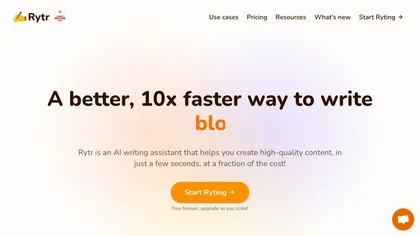
Rytr is an AI writing assistant designed for generating quick, polished content — especially for short-form tasks like social media posts, product descriptions, and email drafts.
Compared to ChatGPT, Rytr feels more focused and purpose-built for writing. ChatGPT is great for brainstorming and idea exploration, but Rytr shines when something formatted, professional, and ready to use is needed with minimal back-and-forth. It also includes a built-in plagiarism checker and supports over 30 languages, making it great for multilingual content creation.
Its library of 40+ pre-designed templates helps users get started faster, especially when they are unsure how to structure a piece.
That said, Rytr is less suited for longer or more complex writing, such as deep-dive articles. But for quick, high-quality content, it’s fast, effective, and affordable — starting at just $9/month. For freelancers, marketers, or small business owners looking for a streamlined writing tool, Rytr is a solid choice.
Sudowrite
Sudowrite is a creative writing assistant and an excellent tool for anyone working on fiction. It’s ideal for overcoming writer’s block, generating fresh ideas, and crafting more vivid narratives.
Features like the ‘Describe’ tool, which helps create immersive descriptions, and ‘Brainstorm,’ which sparks creative plot points, can significantly improve the storytelling process. The ‘Expand’ feature is also useful for turning rough outlines into fully developed drafts.
Unlike ChatGPT or Rytr, Sudowrite isn’t designed for creating emails, product descriptions, or blog posts. Its focus is entirely on fiction—helping writers with dialogue, character building, and narrative structure. For instance, when a writer is stuck on a scene, Sudowrite can provide thoughtful suggestions to enhance pacing and tension. It's a powerful tool against writer's block; even if the suggestions aren't used, they can inspire new ways of thinking about the text.
While it’s not suitable for business writing or technical content, it’s a fantastic choice for novelists, short story writers, or anyone experimenting with creative projects. With plans starting at $19/month, Sudowrite offers a unique way to elevate fiction writing.
The best AI search engines
Google AI Mode
Google’s 'AI Overviews' now appear in search results. Their effectiveness can be inconsistent—sometimes helpful, but often surface-level or incorrect.
Still, Google seems committed to reshaping search, doubling down with its new 'AI Mode', which essentially blends Gemini with traditional search.
For answering straightforward informational questions, it represents a significant step up from clicking through multiple pages to find one specific detail.
Where it struggles is with more nuanced or niche queries. Because large language models generate responses based on statistical patterns in their training data, users are often left with a “most likely” answer rather than a surprising or original one. Traditional search, on the other hand, can lead to obscure blog posts or forgotten forum threads that shift perspectives.
AI Mode is currently free and opt-in, but it would not be surprising if it becomes the default before long.
Perplexity
While ChatGPT Search and Google’s AI mode have gained attention, Perplexity is a go-to choice for users who need fast, trustworthy answers with clearly cited sources that can be verified.
What makes Perplexity feel more reliable is its transparency; users can see where each point of information comes from. In contrast, Google’s AI mode can feel like a black box, as it’s often unclear which part of an answer came from which source.
The free version is great for casual use, but for deeper research, the Pro plan is a worthwhile upgrade.
ChatGPT Search
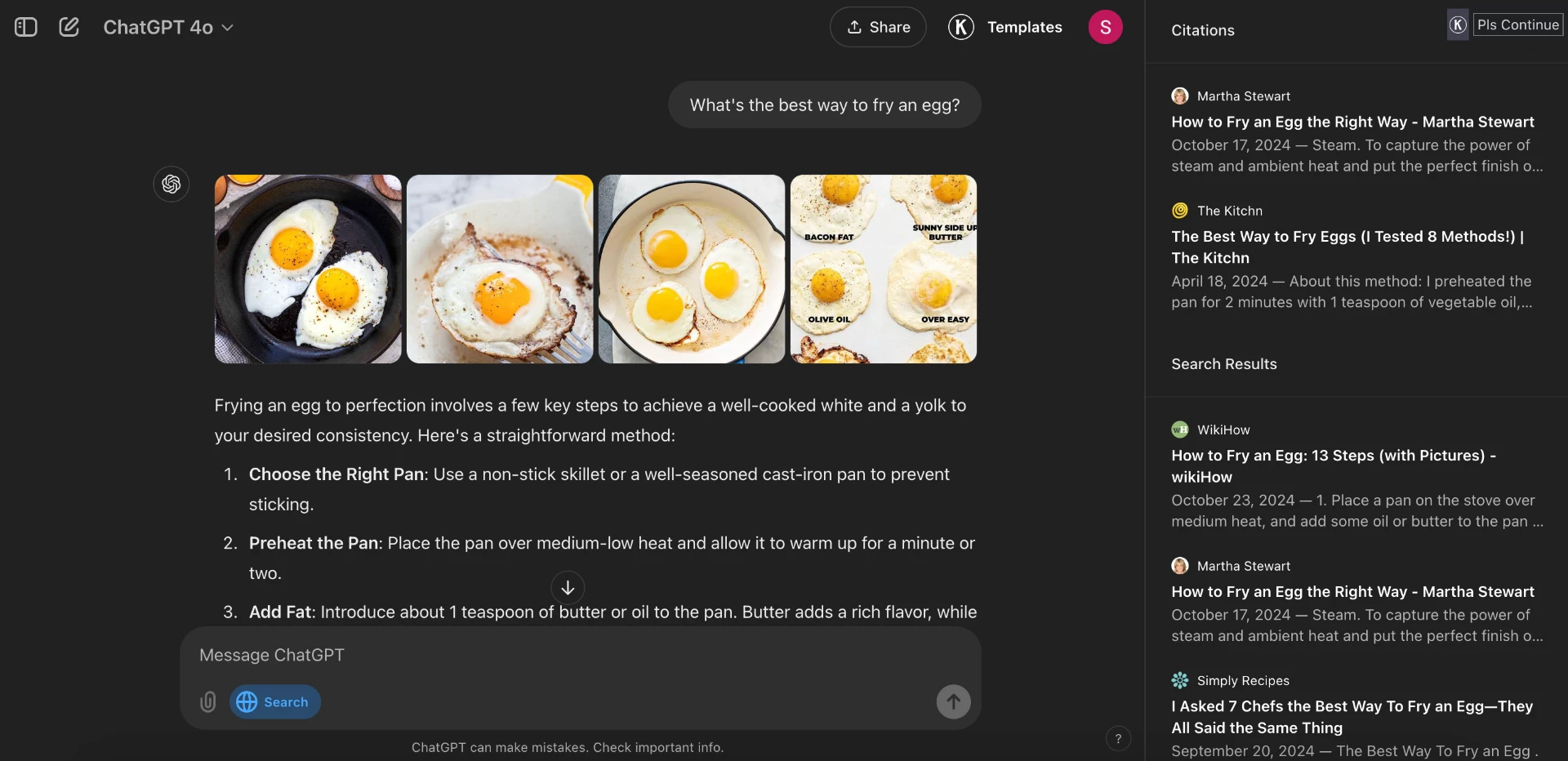
ChatGPT Search is now seamlessly integrated into the platform; when users ask questions, it will often perform a web search automatically without special instruction. It is also still available as an explicit option.
Similar to Google's AI mode and Perplexity, when a question is asked, a summarized answer is provided instead of a list of links. It's also more conversational—it remembers previous questions and follows up in context, making it much easier to dig deeper into a topic without rephrasing the query each time.
A key benefit is the absence of ads. Another valued feature is the ability to customize the output. For example, users can ask for explanations in simpler terms or for responses formatted as a table or CSV file.
ChatGPT Search is now integrated into all ChatGPT plans, including the free plan.
The best AI design tools
Canva Magic Studio
Canva is a hugely popular design tool, known for its ease of use. With the addition of its AI-powered Magic Studio suite, it becomes even more powerful.
Magic Studio includes a variety of features that streamline and enhance the creative process.
Magic Design lets users input a prompt or upload an image to generate personalized templates. It is useful for users short on inspiration, providing a solid starting point.
Magic Write helps craft content by generating text based on prompts, which is handy for overcoming writer’s block and drafting copy.
Magic Edit makes it easy to tweak images by changing colors or removing elements—perfect for quick edits without needing a more complex photo editing tool.
Magic Eraser takes that a step further, allowing for the clean removal of unwanted objects from photos.
Magic Animate adds movement to static designs, helping create engaging presentations or social content.
Canva follows a freemium model. Some Magic Studio tools can be tried for free with limitations. Upgrading to Canva Pro ($15/month) or Canva for Teams ($30/month for 3 seats) increases usage limits.
Looka
Looka is an AI-powered logo and brand design tool. It can be tested on various projects.
It’s very easy to use. Users enter their company name and a short description. Looka then shows sample logos and asks the user to pick their favorites to help train the AI on their style. After choosing a color scheme, a range of AI-generated logos tailored to the business is provided.
The quality is surprisingly high. Once a favorite is chosen, the drag-and-drop editor can be used to make small tweaks.
After selection, Looka generates a brand kit with the logo used on a bunch of different 'brand essentials'.
Looka offers two main pricing options: a one-time Premium Logo Package for $65, which includes high-res files, full ownership, and unlimited edits, or an annual Brand Kit Subscription starting at $96/year that adds branded assets like social posts, business cards, and more. For $129/year, a website can also be bundled with the Brand Kit.
The best AI app builders & coding tools
Lovable
Lovable is a fast-growing startup. The idea of an app that lets anyone—regardless of coding experience—build software just by prompting it into existence is incredibly compelling. And it works surprisingly well.
It can be used to build different apps and websites of increasing complexity, such as a digital marketer portfolio site or a task manager-style productivity app. It can also generate widgets for landing pages that can be embedded with zero fuss.
For non-coders, Lovable opens up a whole new world of possibilities on a computer.
That said, expectations should be realistic. It is not for prompting a fully-fledged, enterprise-grade SaaS business. Those still require thousands of hours from skilled engineers. But what’s exciting about Lovable isn’t just its current state—it’s its future potential.
Pricing is simple: there's a free plan for basic use, a $25/month Pro plan with more features, and custom Enterprise plans for larger teams.
Cursor
For more technical users who want greater control over their code, Cursor is currently the most popular AI-powered IDE (Integrated Development Environment). Pair-programming with an AI can be quite effective.
Cursor is often preferred because it feels familiar — it’s a fork of VS Code, so there’s no learning curve for those who have used it before.
Cursor’s popularity comes down to two key strengths. First, it’s great at navigating large projects — it understands dependencies and offers file-aware suggestions that make sense. Second, it has a strong grasp of development context, like file structure, imports, and naming conventions, which means less time is spent fixing AI-generated code.
Another big plus is its generous free tier. While the Pro plan ($25/month) provides access to more advanced AI models and priority updates, the free version is more than enough for most day-to-day use.
The best AI knowledge management tools
Notion Q&A
Notion Q&A is a powerful tool that helps tap into a company’s entire knowledge base across thousands of Notion pages. This tool has become popular in professional settings.
It allows users to ask any question—without interrupting colleagues—and instantly get a detailed, accurate answer drawn from everything stored in a company Notion workspace and across all connected Slack channels. It feels like having a personal assistant who knows exactly where to find information from every corner of the company.
Notion can also pull answers from other connected external tools, including Google Drive, Github, and Zendesk.
What makes Notion Q&A stand out is that it doesn’t just link to documents. It gives direct answers pulled from the actual content, making it much faster to find what is needed.
It also cites the source of each piece of information so that users can easily see the source and verify key details. This can save countless hours when quick, detailed information is needed.
Notion Q&A is priced as an add-on at $10 per user per month (or $8/month when billed annually). It’s a fair price for what it offers, though it can add up for larger teams.
Guru
Guru is a dedicated knowledge management platform that offers similar functionality to Notion Q&A, but with a key difference: Guru surfaces answers directly in context. That means users can ask Guru questions within tools like Slack or a CRM, and it pulls in relevant information from those platforms automatically. In practice, this makes the responses feel much more useful, since Guru has access to a broader set of real-time data.
In comparison, Guru is ideal for teams that need a comprehensive, integrated knowledge solution that fits into their existing workflows. Notion Q&A, on the other hand, is a lighter, lower-commitment option — and perfect if a team already stores most of its content in Notion.
The downside? Guru is on the pricier side at $15 per user/month.
The best AI email assistants
Hubspot AI Email Writer
HubSpot offers an AI-powered email assistant designed to kickstart creativity and help write personalized emails at scale. The platform’s AI assistant generates copy fit for various email campaigns, like sales outreach, marketing newsletters, and so on.
Users can then edit or repurpose generated drafts by automatically changing their tones as well as lengthening or shortening them. HubSpot also includes a drag-and-drop email template builder with numerous customizable use-case-specific presets, perfect for further streamlining creative processes.
A particularly useful feature is that HubSpot’s AI email writer links with the platform’s CRM database. That means users can roll out email campaigns and automatically log conversations to their contact lists. From there, they can track progress and send out follow-ups at the right time to maximize response rates. Plus, the platform’s AI assistant can be used directly from a Gmail account, sparing the need to juggle between multiple tabs.
HubSpot’s AI Email Writer is a solid choice for busy marketing and sales teams looking to scale up their efforts and maximize results without increasing headcount.
The email writing assistant is available for free, while more advanced email functionalities are available throughout HubSpot’s Marketing Hub paid packages. Pricing starts at $15 per month.
Fyxer
Fyxer is a fast-growing AI executive assistant that claims it can win back at least an hour of a user's day. When tested by connecting it to a work Gmail account, it performs two main functions.
First, after training on past emails, it automatically categorizes incoming emails into sensible folders, which genuinely makes it easier to find specific conversations.
Second, it begins suggesting draft responses. While it takes time for the AI to learn a user's voice, the drafts are surprisingly close to a natural writing style from the start. Of course, it cannot answer highly specific questions if the inbox doesn't contain the answer, but it significantly reduces the number of emails that have to be written from scratch. Editing its suggestions is much faster than starting with a blank email.
Fyxer also includes an AI meeting note taker, which works well, though dedicated tools may be preferred.
Pricing starts at $30/month, with more advanced features at $50 and custom options for enterprise teams. All plans come with a 7-day free trial.
Shortwave
Shortwave is an AI email assistant that helps organize, write, search, and schedule emails.
It doesn’t include an AI meeting note-taker like Fyxer, but that may be fine for those who already use a separate tool for meeting notes.
What Shortwave does offer is excellent email organization, far better search capabilities (a lifesaver for those who constantly dig through old emails), and fast AI-assisted drafting and suggestions.
To compare, Shortwave is great for a personal inbox — it’s lightweight, affordable, and ideal for everyday use. For work, Fyxer might be preferred for its meeting features and deeper automation.
Shortwave has a free plan with AI assistance, inbox customization, and 90 days of searchable history. The Personal Plan is $8.50 per seat/month and adds more power for everyday users.
The best AI scheduling tools
Reclaim
Reclaim is an AI-powered scheduling assistant that helps optimize a calendar by automatically managing tasks, meetings, and breaks based on priorities. Users have found that it significantly reduces the mental effort of planning their day.
After connecting it to a Google Calendar, users enter their tasks and meetings with their priority levels. Reclaim then automatically assigns time slots, ensuring they stay on top of what matters most.
One of the most useful features is how it protects deep work time by blocking off hours for focus and preventing unnecessary meeting overlaps. It’s also great for scheduling with others — it finds optimal meeting times based on everyone’s availability and preferences, cutting down on back-and-forth coordination.
Reclaim offers a free Lite Plan with core time-blocking features, and a Starter Plan at $10/user/month for more advanced scheduling support.
Clockwise
Clockwise is an AI-powered scheduling assistant that optimizes a calendar by managing meetings and protecting blocks of focus time. It helps users stay more organized and get more deep work done.
Once connected to a Google Calendar, certain meetings can be marked as flexible. Clockwise automatically reschedules them to open up longer focus periods, which can noticeably improve productivity.
It also makes meeting coordination easier by finding the best times for all participants. Compared to Reclaim, which handles both task and meeting scheduling, Clockwise focuses more narrowly on optimizing meeting times and creating uninterrupted work windows. Reclaim may be more useful overall because of its broader scope, but Clockwise excels if the main pain point is meeting overload.
Clockwise offers a Free Plan with core calendar optimization features. Paid plans start at $7.75/month.
The best AI presentation makers
Gamma
For professionals who present frequently, any tool that can make that part of the job easier is welcome.
Gamma is great for building presentations from scratch, but it can also be used to turn notes into decks, and even to repurpose existing presentations and PDFs. It handles all three scenarios surprisingly well.
When starting from scratch, users can head to Gamma’s “Generate a Presentation” tool. Typing in a prompt like “I need a presentation explaining the different types of digital marketing channels” and specifying the number of slides yields a solid outline that can be tweaked and reordered. Hitting generate produces a full presentation in seconds.
The quality is genuinely impressive. The generated slides have a sleek design and include AI-generated images that look consistent and professional, often looking much better than what could be made in PowerPoint or Google Slides. Users typically make a few edits, but for the most part, they’re ready to go.
It's also handy that Gamma can export to PowerPoint format (.pptx), which is useful for sharing decks with clients.
Gamma has a Free Plan that includes 400 AI credits, basic image generation, and up to 10 slides per presentation. The Plus Plan ($10/user/month) unlocks unlimited AI creation, more slides, better image tools, and priority support.
Copilot for Powerpoint
While not as slick as Gamma, PowerPoint remains a common tool, especially with the Copilot for PowerPoint feature.
Like Gamma, it lets users generate an entire presentation from an existing file, a few notes, or just a well-written prompt. It’s surprisingly good at pulling together a structured deck from minimal input.
The biggest advantage Copilot has over Gamma is familiarity — almost everyone already knows how to use PowerPoint, so there’s no learning curve.
That said, for those not already using Microsoft 365 for work, paying for Copilot separately might not be ideal. Gamma is more affordable, and many prefer building slides in a modern, web-based tool rather than a traditional desktop program.
For context, Microsoft Copilot for PowerPoint requires either a Copilot Pro subscription at around $20/month, or the Microsoft 365 Copilot add-on at $30/month on top of a qualifying Microsoft 365 plan.
The best AI resume builders
Teal Resume Builder
Teal is an AI-powered resume builder that helps streamline the resume writing process and tailor it to specific job applications — a task many find tedious and time-consuming.
After entering job history, skills, and goals, Teal generates a live resume preview with bullet points based on the provided experience. For example, when adding a past marketing role, it might suggest phrases like “increased engagement by 30%” or “managed a team of 5,” giving the resume a polished, results-driven tone without much effort.
Teal highlights key skills and phrases from a job posting and suggests how to integrate them into the resume. This helps align the resume with the job in just a few clicks.
Teal also has a popular job application tracking tool.
Teal’s Free Plan includes unlimited resumes and job tracking, while the Teal+ Plan costs $29/month and unlocks all premium features.
Kickresume
While Teal offers smart suggestions for tailoring a resume, Kickresume arguably produces a better-looking final product.
It offers over 40 resume templates, which are claimed to be designed by HR experts and typographers. The templates look sleek, professional, and modern. They're also ATS-compliant, providing peace of mind that AI scanners used by most companies will be able to read the resume without issues.
Another nice bonus: Kickresume lets users turn their resume into a personal website with just a few clicks, so a separate tool isn't needed for that.
Kickresume’s Free Plan includes basic resume and cover letter templates, a website builder, and access to 20,000+ pre-written phrases. The Monthly Plan ($19/month) unlocks premium templates, full customization, an AI resume checker, and priority support.
The best AI voice generators
ElevenLabs
ElevenLabs is the clear leader in AI voice generation, offering text-to-speech and voice cloning capabilities.
The tool offers a high degree of flexibility, and the AI-generated voices sound very natural. Users can adjust the language, voices, and the number of speakers. A notable feature is the voice tags functionality, which allows control over the delivery and emotions of the generated speech, making it possible to change from [whispers] to [sarcastic] and then to [laughs] all within the same passage of text.
The voice cloning feature can be an interesting experience. Once cloned, a user's own voice can be prompted via text-to-speech. The resulting AI voice can sound remarkably similar to the original.
ElevenLabs AI Dubbing Studio is another impressive feature for creating voiceovers and dubbing content in multiple languages. Uploading a video allows for the quick generation of high-quality voiceover tracks in different voices and accents. While it's a bit pricey and lacks video dubbing/lip-sync capabilities, it's a neat extra set of features.
ElevenLabs offers a free plan with 10k credits, while paid plans start at $5/month for more credits, voice cloning, and commercial use. Higher tiers unlock pro features like better audio quality and API access for large-scale projects.
Murf
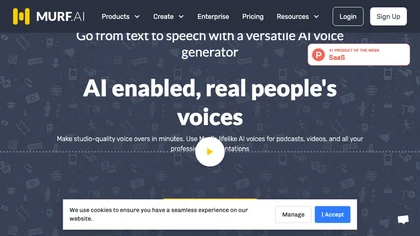
For projects that need narration, an AI-generated voice is often a good solution. It saves the hassle of setting up a microphone and dealing with noise cancellation.
While ElevenLabs is the undisputed leader in AI voice quality, Murf can be a better option for non-technical users.
Murf has a clean, drag-and-drop interface that makes it easy to create voiceovers quickly. It might not have the same technical depth or realism as ElevenLabs, but it still delivers solid results — especially for things like explainer videos or internal presentations.
Murf’s Free Plan gives you 10 minutes of voice generation and transcription, access to 120+ voices, and basic audio/video sharing. The Creator Plan, at $29/month, unlocks unlimited downloads, 200+ voices, 2 hours of voice generation per month, and commercial usage rights.
The best AI music generators
Suno
In a professional context, Suno is used to generate background music for social posts, videos, and ads. It’s perfect for creating original, royalty-free tracks that sound great from a simple prompt.
Suno is also one of the most fun tools on this list and is often used for creative experimentation with new songs in the style of favorite artists.
For example, an awesome track could be generated with this prompt:
A high-energy, funky pop song in the style of Michael Jackson (circa "Bad" era), about the late-night grind of writing a blog post. Catchy verses about researching, editing, and battling writer's block, with a smooth, soulful chorus that celebrates hitting publish. Include MJ-style ad-libs ("hee-hee!", "shamone!") and signature vocal flair.
While AI music still lacks the emotional depth of human-made songs, it’s incredibly fun and useful for creative projects. We may not be listening to AI tracks for pure enjoyment just yet, but the technology is getting closer.
Suno’s free plan includes 50 daily credits for up to 10 songs a day (personal use only). The $10/month Pro plan gives you 2,500 credits, commercial rights, faster generation, and the ability to run 10 tasks at once.
For public-facing work, the Pro plan is needed for the commercial license.
Udio
Udio is better suited for musicians who want to use AI as a starting point and then iterate on their creations. Its editing options are more flexible than Suno’s—though still not quite on par with traditional music production software.
For those who want more control over how a song comes together, Udio is a strong choice. It lets users shape, tweak, and refine everything—whether that’s regenerating a chorus, extending a verse, or fine-tuning the lyrics.
It’s not as fast or polished out of the box as Suno, but if structure and customization are important, Udio is the stronger option.
Udio offers a free plan with 100 credits per month for up to 50 songs and basic tools. For more, the Standard Plan costs $10/month.
The best AI marketing tools
AdCreative
AdCreative is an AI-powered platform that streamlines the process of creating ad creatives for platforms like Facebook, Instagram, and Google Ads. It is a convenient, time-saving tool that produces professional results.
For someone without a design background, it offers a quick way to create usable ads. By entering basic campaign details—like the product and target audience—the tool generates multiple polished ad designs tailored for different platforms. The generated designs typically only need minor tweaks.
The interface is intuitive and beginner-friendly. Users can easily adjust text, swap images, and add a logo to match their branding. AdCreative makes it simple to generate multiple ad variations for A/B testing with slight changes in headlines or visuals.
Pricing starts at $39/month, which is reasonable for frequent users and far cheaper than hiring a designer. But for occasional use—especially if the outputs need heavy editing—the cost might feel a bit steep.
AirOps
AirOps is marketed as a content operations engine, with a core focus on scalable content creation. While it is primarily used for generating blog posts, it can also be used to refresh landing pages, suggest ad copy, check backlink quality, and produce SEO metadata for hundreds of pages at once. It saves users from boring, repetitive tasks and lets them focus on higher-value work.
Building complex workflows is easy thanks to the drag-and-drop interface. There are plenty of standard steps, but the “power steps” are especially useful — prebuilt modules that handle common tasks like keyword research or identifying content cannibalization.
One of its best features is the range of models available. AirOps lets users build workflows using the latest ChatGPT, Claude, and Gemini models, with support for LLMs, image models, and (most likely) video models soon.
The quality of the output really depends on the quality of the workflow built, but AirOps makes learning easy. They offer helpful tutorials and frequently host webinars featuring well-known names in SEO and content marketing who share how they use the platform.
It’s not the cheapest tool, but it’s incredibly powerful — and its role across marketing teams will only grow as it continues to evolve.